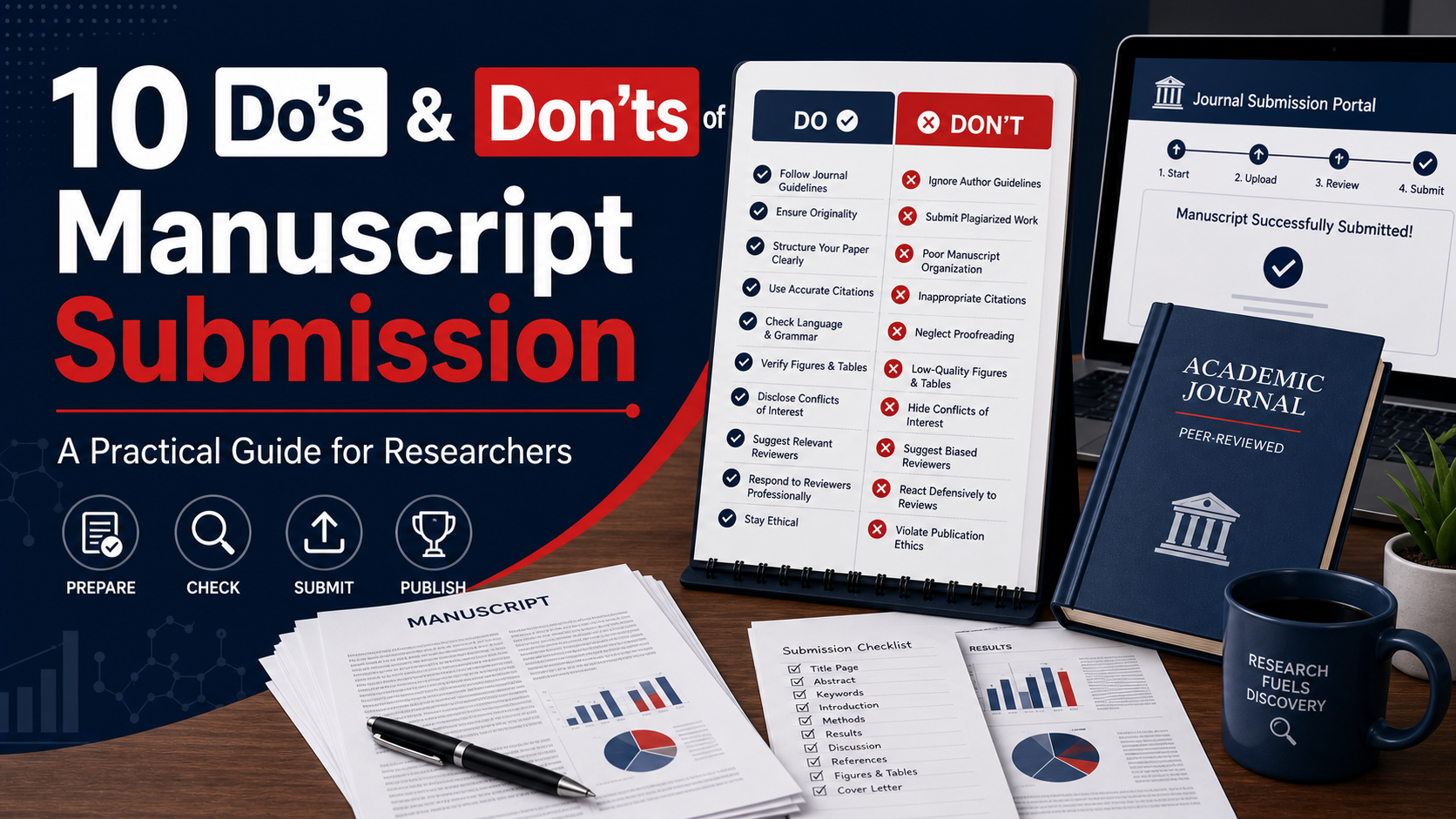
10 Do's and Don'ts of Manuscript Submission
Submitting a research manuscript is a critical milestone in the publication journey. Yet many manuscripts face delays, desk rejections, or major revisions because authors overlook simple but important submission practices.
A strong manuscript deserves an equally strong submission strategy.
This guide outlines 10 practical do's and don'ts that every researcher should follow before submitting their work to a journal.
Why Manuscript Submission Matters
The submission stage is often underestimated.
Researchers spend months conducting experiments, collecting data, analyzing results, and writing the manuscript. However, a poorly planned submission can create unnecessary obstacles.
Common issues include:
• Journal mismatch
• Incomplete documentation
• Formatting errors
• Missing ethical statements
• Weak cover letters
Fortunately, most of these problems are preventable.
10 DO's of Manuscript Submission
1. Do Choose a Journal That Matches Your Research
Before submission, carefully review the journal's aims and scope.
Ask:
• Does the journal publish similar studies?
• Is your target audience aligned?
• Are recently published articles relevant to your topic?
A strong journal fit significantly improves your chances of progressing to peer review.
2. Do Read the Author Guidelines Thoroughly
Every journal has specific submission requirements.
Pay attention to:
• Manuscript structure
• Reference style
• Word limits
• Figure requirements
• Supplementary materials
Ignoring guidelines creates a poor first impression.
3. Do Write a Professional Cover Letter
A well-written cover letter helps editors quickly understand:
• The purpose of your study
• Its novelty
• Why it fits the journal
Keep it concise, professional, and focused.
4. Do Verify All References
Check every citation for:
• Accuracy
• Consistency
• Completeness
Broken references or incorrect citations reduce credibility.
5. Do Ensure Ethical Compliance
Include all relevant information regarding:
• Ethical approval
• Informed consent
• Conflict of interest declarations
• Funding disclosures
Transparency is essential.
6. Do Perform a Final Language Review
Even excellent research can be weakened by unclear writing.
Review:
• Grammar
• Clarity
• Consistency
• Scientific terminology
A final proofreading round is always worthwhile.
7. Do Check Figures and Tables Carefully
Ensure:
• High resolution
• Correct numbering
• Clear labels
• Consistent formatting
Visual elements often receive immediate attention from reviewers.
8. Do Prepare for Reviewer Questions
Before submission, critically evaluate your own manuscript.
Ask:
• What weaknesses might reviewers identify?
• Are limitations acknowledged?
• Are conclusions supported by data?
Anticipating concerns improves manuscript quality.
9. Do Keep Supporting Documents Ready
Many journals require additional files such as:
• Cover letter
• Ethics statements
• Author contribution forms
• Supplementary data
Preparing them in advance streamlines the process.
10. Do Double-Check Submission Details
Before clicking "Submit":
• Confirm author names
• Verify affiliations
• Check corresponding author information
• Review uploaded files
Small mistakes can create major delays.
10 DON'Ts of Manuscript Submission
1. Don't Submit Without Checking Journal Scope
One of the most common causes of desk rejection is poor scope alignment.
A good paper submitted to the wrong journal remains a poor submission.
2. Don't Ignore Formatting Requirements
Editors often assess compliance before scientific merit.
Incorrect formatting may signal a lack of attention to detail.
3. Don't Oversell Your Findings
Avoid exaggerated claims.
Strong research speaks for itself.
Maintain an objective and evidence-based tone.
4. Don't Submit Multiple Versions of the Same File
Ensure all uploaded files are:
• Final
• Correctly named
• Updated
Version confusion can create unnecessary complications.
5. Don't Hide Study Limitations
Every study has limitations.
Acknowledging them demonstrates scientific maturity and credibility.
6. Don't Neglect Plagiarism Checks
Always review your manuscript before submission.
Even accidental similarities can cause problems during editorial screening.
7. Don't Use Generic Cover Letters
Editors can easily identify template-style submissions.
Personalize the letter for the target journal.
8. Don't Ignore Ethical Requirements
Missing declarations regarding ethics or conflicts of interest may delay review or result in rejection.
9. Don't Rush the Submission Process
Many mistakes occur when authors submit immediately after finishing the manuscript.
Take time for a final review.
10. Don't Take Rejection Personally
Rejection is part of academic publishing.
Use reviewer feedback as an opportunity to improve your work and strengthen future submissions.
Quick Pre-Submission Checklist
Before submitting your manuscript, confirm:
✅ Journal scope matches your study
✅ Author guidelines followed
✅ References verified
✅ Ethics statements included
✅ Figures and tables checked
✅ Cover letter prepared
✅ Plagiarism review completed
✅ Supporting documents ready
✅ Author information verified
✅ Final files uploaded correctly
Final Thoughts
Successful manuscript submission is not just about producing quality research.
It is about presenting that research professionally, ethically, and strategically.
By following these 10 do's and avoiding these 10 don'ts, researchers can minimize avoidable errors and increase the likelihood of a smoother editorial and peer-review process.
A strong submission does not guarantee acceptance.
But it significantly improves your chances of being evaluated fairly and efficiently.
Frequently Asked Questions
How important is journal selection before submission?
Journal selection is one of the most important decisions in the publication process. A mismatch can result in immediate desk rejection.
Should I submit immediately after finishing my manuscript?
No. A final review for formatting, language, references, and supporting documents is highly recommended.
Does a cover letter really matter?
Yes. A professional cover letter helps editors quickly understand the relevance and contribution of your work.
What is the most common submission mistake?
Failing to follow journal author guidelines remains one of the most frequent and avoidable mistakes.