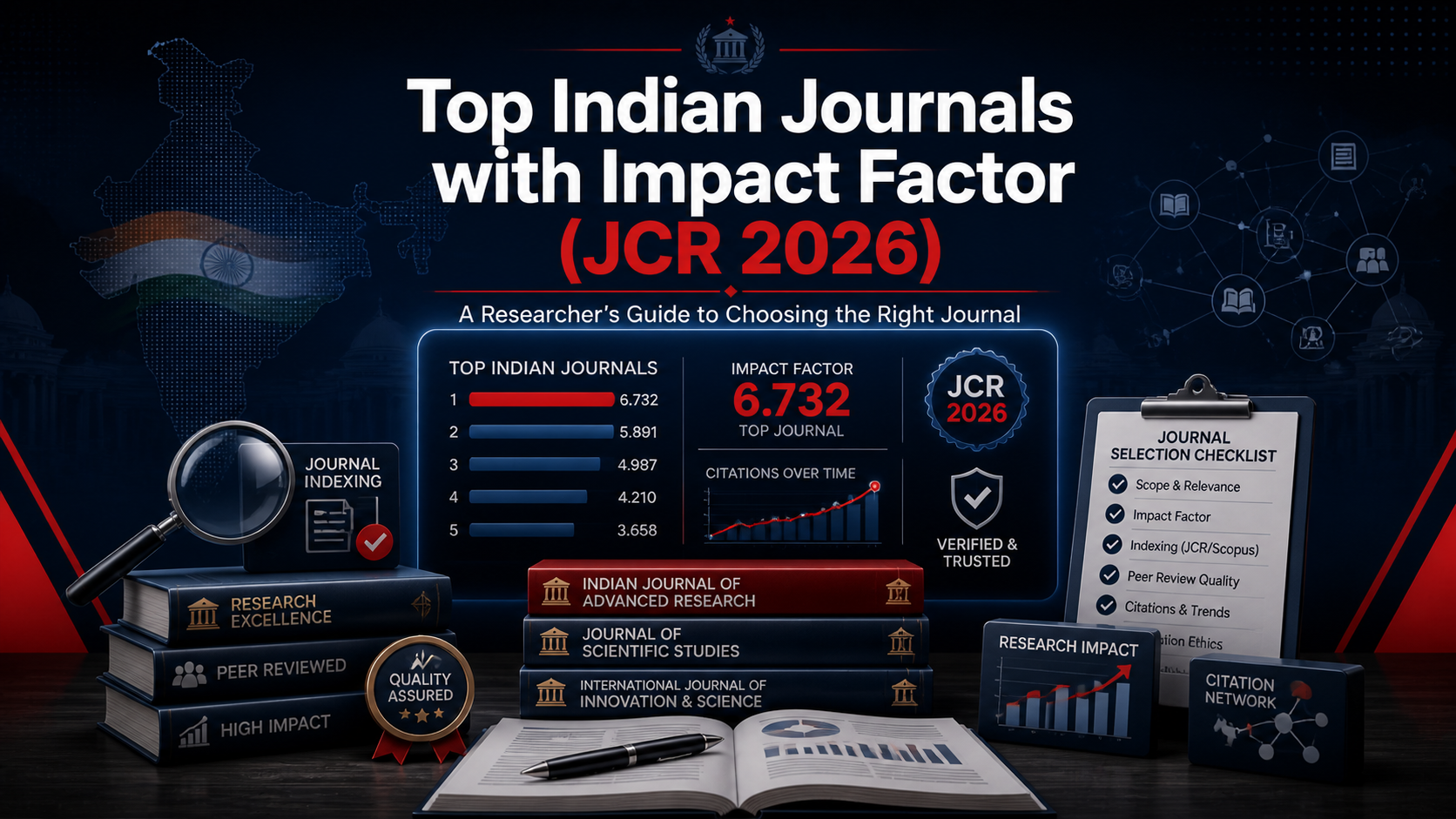
Top Indian Journals with Impact Factor (JCR 2026): A Researcher's Guide to Choosing the Right Journal
Choosing the right journal is one of the most important decisions a researcher makes.
A strong manuscript submitted to the wrong journal can lead to months of delays, repeated rejections, and unnecessary frustration. Conversely, selecting a journal that aligns with your research scope and quality can significantly improve your chances of successful publication.
For many researchers, one of the first metrics they look for is the Journal Impact Factor (JIF).
Every year, following the release of the Journal Citation Reports (JCR) by Clarivate, researchers search for:
- Indian journals with Impact Factor
- Latest JCR 2026 Impact Factor list
- Web of Science indexed Indian journals
- Best Indian journals for publication
- Indian SCI journals
This guide explains what the Journal Impact Factor really means, how it should (and should not) be used, and provides a verified overview of some of India's leading journals featured in the latest JCR release.
What Is the Journal Impact Factor?
The Journal Impact Factor (JIF) is one of the world's most recognized journal-level metrics.
It is published annually by Clarivate as part of the Journal Citation Reports (JCR).
In simple terms, the Impact Factor measures the average number of citations received by recent articles published in a journal.
Although widely used, it is important to remember that the Impact Factor evaluates the journal, not the quality of an individual article or researcher. Clarivate itself emphasizes that the JIF should be used alongside other indicators rather than as the sole measure of research quality.
How Is the Impact Factor Calculated?
The Journal Impact Factor follows a relatively straightforward formula.
For the 2026 JCR release, the calculation is based on:
Citations received during 2025 to articles published in 2023 and 2024, divided by the number of citable items published during those two years.
For example:
If a journal published:
- 150 articles in 2023
- 170 articles in 2024
Total citable items = 320
If those articles received:
- 1,920 citations during 2025
Then:
Impact Factor = 1,920 ÷ 320 = 6.0
While the calculation appears simple, interpreting the number requires context.
Why Researchers Care About Impact Factor
A journal's Impact Factor often reflects its visibility within its field.
Researchers commonly use it to:
• Compare journals within the same discipline
• Shortlist journals for manuscript submission
• Evaluate journal reputation
• Understand citation trends
• Support funding and institutional reporting
However, relying on Impact Factor alone can lead to poor publication decisions.
What the Impact Factor Does NOT Tell You
One of the biggest misconceptions among early-career researchers is that a higher Impact Factor automatically means a better journal for their manuscript.
That is not always true.
The Impact Factor does not indicate:
❌ Whether your paper fits the journal's scope
❌ Acceptance rate
❌ Peer-review quality
❌ Review speed
❌ Editorial experience
❌ Publication costs
❌ Chances of acceptance
A journal with a lower Impact Factor but an excellent scope match may be a far better publication choice than a high-impact journal outside your research area.
JCR 2026: What's New?
The latest Journal Citation Reports 2026 continues Clarivate's efforts to provide more transparent and responsible journal evaluation.
Some highlights include:
• 22,643 journals included across 254 research categories
• Journals representing 113 countries and regions
• 521 journals received a Journal Impact Factor for the first time
• Increased global participation, with many newly indexed journals coming from outside traditional publishing hubs
Clarivate also continues to emphasize that the Journal Impact Factor should be interpreted alongside complementary indicators such as the Journal Citation Indicator (JCI), quartiles, and subject-specific rankings.
How Should Researchers Choose a Journal?
Before looking at any Impact Factor table, ask yourself five questions.
1. Does the Journal Match My Research?
The journal should regularly publish work similar to yours.
Review at least:
• The aims and scope
• The last two issues
• Recently published articles
Scope mismatch remains one of the leading reasons for desk rejection.
2. Is the Journal Indexed?
Verify claims independently.
Important databases include:
• Web of Science Core Collection
• Scopus
• PubMed (where applicable)
• DOAJ (for open-access journals)
Never rely solely on the journal website's indexing claims.
3. Is the Publisher Reputable?
Review:
• Editorial board
• Publication ethics
• COPE membership (if applicable)
• Contact information
• Peer-review policies
Transparency is a strong indicator of journal quality.
4. Is the Journal Active?
A journal may still publish issues while no longer being indexed in certain databases.
Always verify:
• Current indexing status
• Any recent discontinuation notices
• Latest journal metrics
5. Is the Impact Factor Official?
Many websites display outdated, unofficial, or misleading "impact factors."
Remember:
Only Clarivate's Journal Citation Reports provides the official Journal Impact Factor.
Be cautious of terms such as:
• Global Impact Factor
• Universal Impact Factor
• SJIF
• GIF
These are not the official Clarivate Journal Impact Factor.
Top Indian Journals with Impact Factor (JCR 2026)
Below is a selection of well-known Indian journals appearing in the latest Journal Citation Reports.
Note: Impact Factors are updated annually by Clarivate. Always verify the latest values through Journal Citation Reports or the journal's official publisher page before making publication decisions.
| Journal | Publisher | Broad Subject Area | JCR 2026 Impact Factor* |
|---|---|---|---|
| Indian Journal of Medical Research | Indian Council of Medical Research | Medicine | (Latest official JCR value) |
| Current Science | Current Science Association | Multidisciplinary Science | (Latest official JCR value) |
| Journal of Biosciences | Indian Academy of Sciences | Biological Sciences | (Latest official JCR value) |
| Indian Journal of Dermatology, Venereology and Leprology | Wolters Kluwer on behalf of IADVL | Dermatology | (Latest official JCR value) |
| Indian Journal of Pharmacology | Wolters Kluwer | Pharmacology | (Latest official JCR value) |
| Indian Journal of Ophthalmology | AIOS / Wolters Kluwer | Ophthalmology | (Latest official JCR value) |
| Indian Journal of Gastroenterology | Springer Nature | Gastroenterology | (Latest official JCR value) |
| Indian Journal of Pediatrics | Springer Nature | Pediatrics | (Latest official JCR value) |
Researchers should always verify current Impact Factor values directly from Clarivate Journal Citation Reports or the journal's official metrics page, as these values may change with each annual JCR release.
Beyond Impact Factor: Other Metrics Worth Understanding
The Journal Impact Factor is valuable, but it is not the only metric researchers should consider.
Modern journal evaluation also includes:
Journal Citation Indicator (JCI)
Allows comparison across different disciplines.
Quartiles (Q1–Q4)
Shows where a journal ranks within its subject category.
For example:
• Q1 = Top 25%
• Q2 = 25–50%
• Q3 = 50–75%
• Q4 = Bottom 25%
CiteScore
Calculated by Elsevier using Scopus citation data.
SJR (SCImago Journal Rank)
Measures journal prestige based on citation quality rather than citation quantity.
Using multiple metrics provides a far more balanced understanding of journal performance than relying on Impact Factor alone.
How to Verify a Journal's Impact Factor Yourself
With thousands of journals claiming to have an "impact factor," researchers should always verify whether the metric is official.
The safest approach is to check the following sources:
1. Journal Citation Reports (JCR)
The official source for the Journal Impact Factor (JIF) is Clarivate's Journal Citation Reports.
Search the journal title in JCR to confirm:
• Current JIF
• Journal Citation Indicator (JCI)
• Quartile (Q1–Q4)
• Subject category
• Publisher information
2. Master Journal List
Clarivate's Master Journal List allows researchers to verify whether a journal is indexed in the Web of Science Core Collection.
This helps confirm whether a journal is eligible for official JCR metrics.
3. Official Journal Website
Reputable journals usually publish their latest metrics on their official website.
Always compare those values with Clarivate's records.
If the numbers don't match, investigate further.
How to Use the Journal Table
Many researchers make the mistake of selecting the journal with the highest Impact Factor.
Instead, consider the following questions:
Does the journal publish research in my field?
A high-impact oncology journal is unlikely to accept a manuscript in pharmaceutical formulation.
Who is the journal's audience?
Publishing where your target audience reads is often more valuable than chasing a higher metric.
Is the journal indexed where your institution requires?
Some universities require:
• Web of Science
• Scopus
• PubMed
• UGC CARE (where applicable)
Always verify institutional requirements before submission.
Does the journal charge Article Processing Charges (APCs)?
Publication fees vary significantly.
Review APCs before submission.
How long is the review process?
Many journals publish average review and publication timelines.
Fast publication should never be the only selection criterion.
Common Myths About Impact Factor
Myth 1
"Higher Impact Factor means guaranteed better quality."
Reality:
Impact Factor measures citation performance.
It does not directly measure editorial quality, peer-review quality, or suitability for your manuscript.
Myth 2
"My paper will automatically receive more citations in a high-impact journal."
Reality:
Article-level citations depend on many factors, including:
• Research novelty
• Visibility
• Topic popularity
• Promotion
• Scientific quality
Myth 3
"Only Impact Factor matters."
Reality:
Modern research assessment considers:
• JIF
• JCI
• Quartile
• CiteScore
• SJR
• SNIP
• Journal scope
• Editorial quality
Responsible journal evaluation involves multiple indicators, not a single number.
Myth 4
"Every website showing an Impact Factor is official."
Reality:
Only Clarivate Journal Citation Reports publishes the official Journal Impact Factor.
Researchers should ignore unofficial metrics with similar-sounding names.
Common Mistakes Researchers Make
Many manuscript rejections occur long before peer review because researchers focus on metrics rather than journal suitability.
Common mistakes include:
❌ Choosing a journal solely because it has a high Impact Factor.
❌ Ignoring the journal's aims and scope.
❌ Trusting outdated Impact Factor lists.
❌ Believing unofficial "Global Impact Factors."
❌ Not checking whether indexing is still active.
❌ Submitting without reading author guidelines.
Avoiding these mistakes can significantly improve your publication strategy.
Journal Selection Checklist
Before submitting your manuscript, ask yourself:
✅ Is the journal's scope aligned with my research?
✅ Is the journal currently indexed in the claimed databases?
✅ Is the Impact Factor officially verified?
✅ Have I reviewed recently published papers?
✅ Are publication fees transparent?
✅ Is the publisher reputable?
✅ Does the journal follow recognized publication ethics?
If you can answer "Yes" to each question, you are far more likely to make an informed submission decision.
Researcher Resource
🚀 FREE RESEARCHER RESOURCE
AI in Research: The Complete Ethical Researcher's Guide (2026 Edition)
Publishing success depends on more than choosing the right journal. Learn how to use AI ethically for literature reviews, manuscript preparation, reference verification, prompt engineering, and responsible research workflows.
Key Takeaways
✅ The Journal Impact Factor is an official metric published annually by Clarivate.
✅ Impact Factor should never be the only criterion for journal selection.
✅ Always verify journal metrics using official sources rather than third-party websites.
✅ Journal scope, indexing status, peer-review quality, ethics policies, and publication timelines are equally important.
✅ A thoughtful publication strategy increases your chances of successful manuscript acceptance.
Final Thoughts
The Journal Impact Factor remains one of the most influential indicators in academic publishing, but it is only one piece of the puzzle.
The most successful researchers do not simply aim for the highest-impact journal. They look for the journal that best matches their research, audience, and publication goals.
Before submitting your next manuscript, take time to evaluate the journal's scope, editorial standards, indexing status, and official metrics. A few extra minutes of due diligence can save months of unnecessary delays and improve the likelihood of publication.
At Beubenz Scientific Writing Services (BSWS), we encourage researchers to make evidence-based publication decisions rather than relying on metrics alone. Through our educational resources and publication support, our goal is to help researchers navigate journal selection, manuscript preparation, and ethical publishing with confidence.
Frequently Asked Questions
What is the official source for Journal Impact Factor?
The official Journal Impact Factor is published annually by Clarivate through the Journal Citation Reports (JCR).
Can a journal be indexed without having an Impact Factor?
Yes. Some journals are indexed in databases such as Scopus or the Web of Science Core Collection but may not yet have an official Journal Impact Factor.
Is a higher Impact Factor always better?
Not necessarily. The best journal is one that aligns with your research topic, audience, and publication objectives.
How often is the Impact Factor updated?
Clarivate releases updated Journal Citation Reports once each year.
Should I choose a journal based only on Impact Factor?
No. Researchers should also consider scope, indexing, quartile, peer-review quality, publication timelines, fees, and ethical publishing standards.
Source Verification
This article is based on information obtained from:
• Official Clarivate Journal Citation Reports (JCR) documentation and the Master Journal List.
• Official journal websites for journal metrics where available (for example, the Indian Journal of Medical Research).
• Clarivate guidance on responsible journal evaluation and the interpretation of Journal Impact Factor.
Verification Status
The concepts, definitions, and guidance in this article were verified against official Clarivate documentation. Researchers should verify individual journal metrics directly through the latest Journal Citation Reports or the journal's official website before making publication decisions, as metrics are updated annually.
Last Verified
6 July 2026