
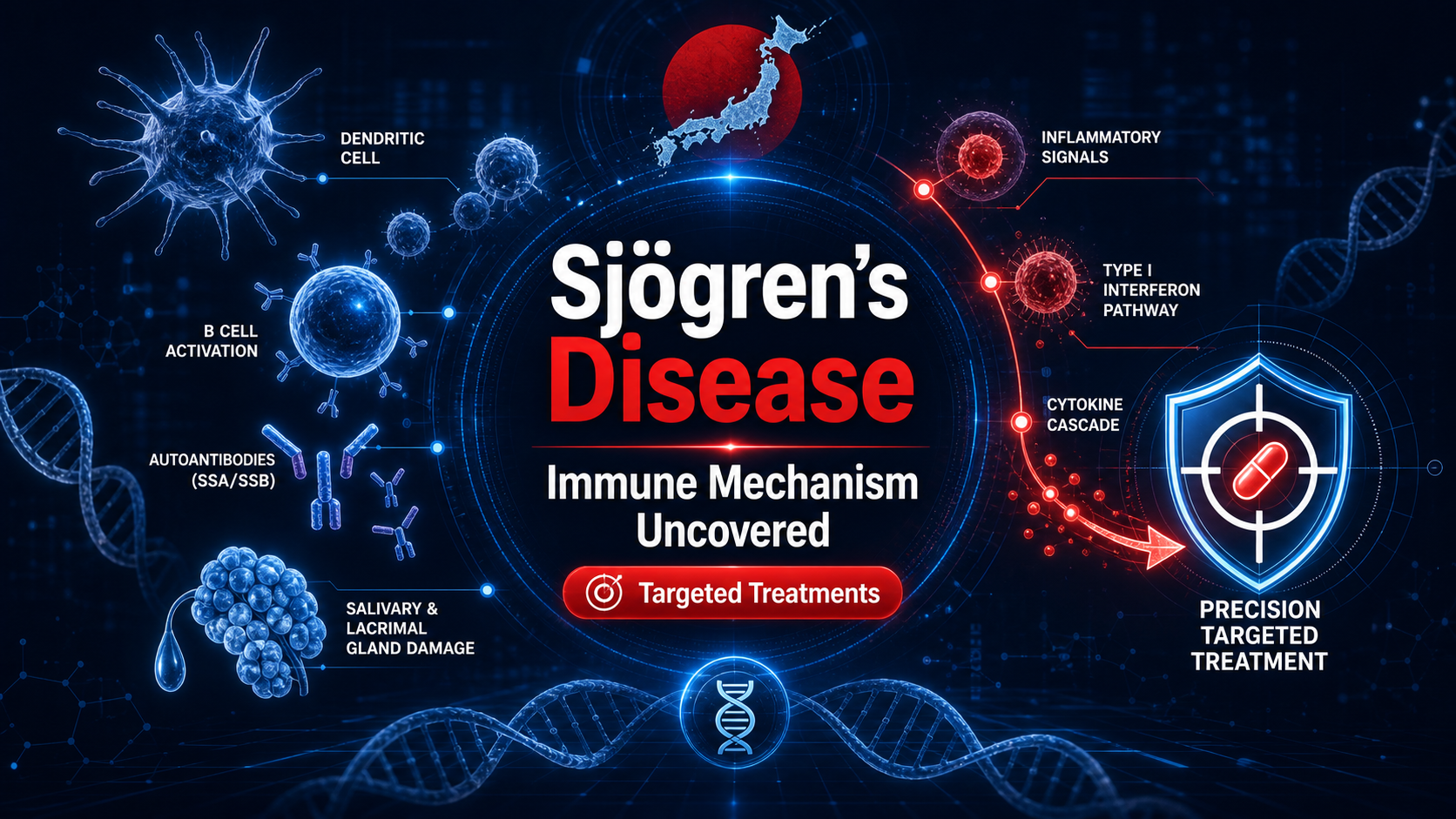
Japanese Scientists Uncover Immune Mechanism Driving Sjögren's Disease: A Step Toward More Targeted Treatments
In a significant breakthrough for autoimmune disease research, scientists from Keio University School of Medicine in Japan have identified a previously unknown immune-cell feedback loop that appears to drive Sjögren's disease.
The discovery, published in Science Advances and announced in June 2026, sheds new light on how immune cells interact to sustain chronic autoimmune responses. More importantly, it opens the possibility of developing therapies that specifically target disease-causing immune activity rather than suppressing the immune system as a whole.
What Is Sjögren's Disease?
Sjögren's disease is a chronic autoimmune disorder in which the immune system mistakenly attacks the body's own exocrine glands, particularly the salivary and tear glands.
Common symptoms include:
• Dry mouth
• Dry eyes
• Fatigue
• Joint pain
• Glandular inflammation
In more severe cases, the disease can affect the lungs, kidneys, skin, nervous system, and other organs. Despite affecting millions of people worldwide, there is currently no cure, and treatment often relies on broad immunosuppressive medications.
The Problem With Current Treatments
Most existing therapies work by suppressing large portions of the immune system.
While these treatments can reduce symptoms, they often:
• Increase infection risk
• Affect healthy immune responses
• Cause long-term side effects
• Fail to address the underlying disease mechanism
Researchers have therefore been searching for more targeted approaches that attack the root cause of autoimmune activity.
What Did the Researchers Discover?
The research team, led by Assistant Professor Masaru Takeshita from Keio University School of Medicine, focused on understanding how immune cells behave within the salivary glands of patients with Sjögren's disease.
Using advanced techniques including:
• Single-cell RNA sequencing
• T-cell receptor (TCR) analysis
• Engineered immune-cell assays
the team analyzed immune cells directly isolated from affected tissues.
Their investigation revealed something researchers had not previously identified:
Disease-associated CD4+ T cells that recognize the same Ro60 protein targeted by harmful autoantibodies in Sjögren's disease.
Understanding the "Immune Feedback Loop"
The most important finding was the discovery of a self-reinforcing autoimmune cycle.
The process works roughly as follows:
Step 1
B cells produce anti-Ro60 autoantibodies.
Step 2
These antibodies bind to Ro60 proteins released from damaged cells.
Step 3
The resulting immune complexes are captured by antigen-presenting cells.
Step 4
These cells activate specific CD4+ T cells by presenting Ro60-derived fragments.
Step 5
Activated T cells stimulate B cells to produce even more autoantibodies.
Step 6
The cycle repeats continuously.
This creates a "vicious cycle" in which T cells and B cells continually reinforce one another, sustaining chronic autoimmune inflammation.
Why Is This Discovery Important?
For years, researchers knew that B cells played a major role in Sjögren's disease.
However, the precise interaction between T cells and B cells remained unclear.
This study provides direct evidence showing how both cell types cooperate to perpetuate disease activity.
The findings help answer a critical question:
Why does the autoimmune response continue even after the initial trigger may have disappeared?
The newly identified feedback loop provides a plausible explanation.
Potential Impact on Future Treatments
One of the most exciting implications of the study is the possibility of targeted intervention.
Instead of broadly suppressing the immune system, future therapies could focus on disrupting specific steps within this pathogenic loop.
Potential benefits include:
• Reduced side effects
• Lower infection risk
• Improved treatment precision
• Better long-term disease control
• Preservation of healthy immune functions
According to the researchers, interrupting this disease-specific immune interaction could selectively suppress harmful autoimmune activity while leaving normal immune responses intact.
Why Ro60 Matters
Ro60 is a protein frequently targeted by autoantibodies in Sjögren's disease.
The study demonstrated that both:
• Pathogenic B cells
• Disease-associated CD4+ T cells
recognize components of the same protein.
This shared target appears to be a crucial factor enabling the feedback loop.
The discovery may help researchers identify new biomarkers and therapeutic targets in the future.
A Discovery With Global Relevance
An especially important aspect of the research was that the findings were consistent across patients from different ethnic backgrounds.
The mechanism was observed in both:
• Japanese patients
• Caucasian patients
This suggests that the newly identified autoimmune pathway may represent a common feature of anti-Ro60-positive Sjögren's disease worldwide.
What This Means for Pharmaceutical Research
Autoimmune diseases remain among the most challenging therapeutic areas in medicine.
This discovery demonstrates how modern technologies such as:
• Single-cell sequencing
• Immune profiling
• Cellular engineering
are transforming our understanding of disease mechanisms.
The findings could influence future research not only in Sjögren's disease but also in other autoimmune conditions where similar immune-cell interactions may occur.
Key Takeaways
✅ Researchers identified a previously unknown immune-cell feedback loop in Sjögren's disease.
✅ The loop involves interactions between CD4+ T cells and antibody-producing B cells.
✅ The mechanism appears to sustain chronic autoimmune inflammation.
✅ The discovery was published in Science Advances in June 2026.
✅ Findings may enable more targeted therapies with fewer side effects than current immunosuppressive treatments.
Final Thoughts
The discovery by researchers at Keio University School of Medicine represents a meaningful step forward in understanding Sjögren's disease.
By identifying the cellular interactions that sustain autoimmune activity, scientists are moving closer to therapies that target the root cause of disease rather than simply controlling symptoms.
While clinical applications may still require further research and validation, the study provides valuable insight into one of the most important unanswered questions in autoimmune medicine: how chronic immune attacks sustain themselves over time.
For patients, clinicians, and researchers alike, that knowledge could ultimately translate into safer and more effective treatment options.
Frequently Asked Questions
What is Sjögren's disease?
Sjögren's disease is a chronic autoimmune disorder in which the immune system attacks moisture-producing glands, causing symptoms such as dry eyes and dry mouth.
What did the Japanese researchers discover?
They identified a previously unknown feedback loop between CD4+ T cells and B cells that helps sustain autoimmune responses in Sjögren's disease.
Why is this discovery important?
The finding provides a potential target for developing more precise treatments that selectively block disease-causing immune activity.
Where was the research published?
The study was published in Science Advances and announced by Keio University School of Medicine in June 2026.
Will this lead to new treatments immediately?
Not immediately. Additional research and clinical studies will be needed before potential therapies become available.