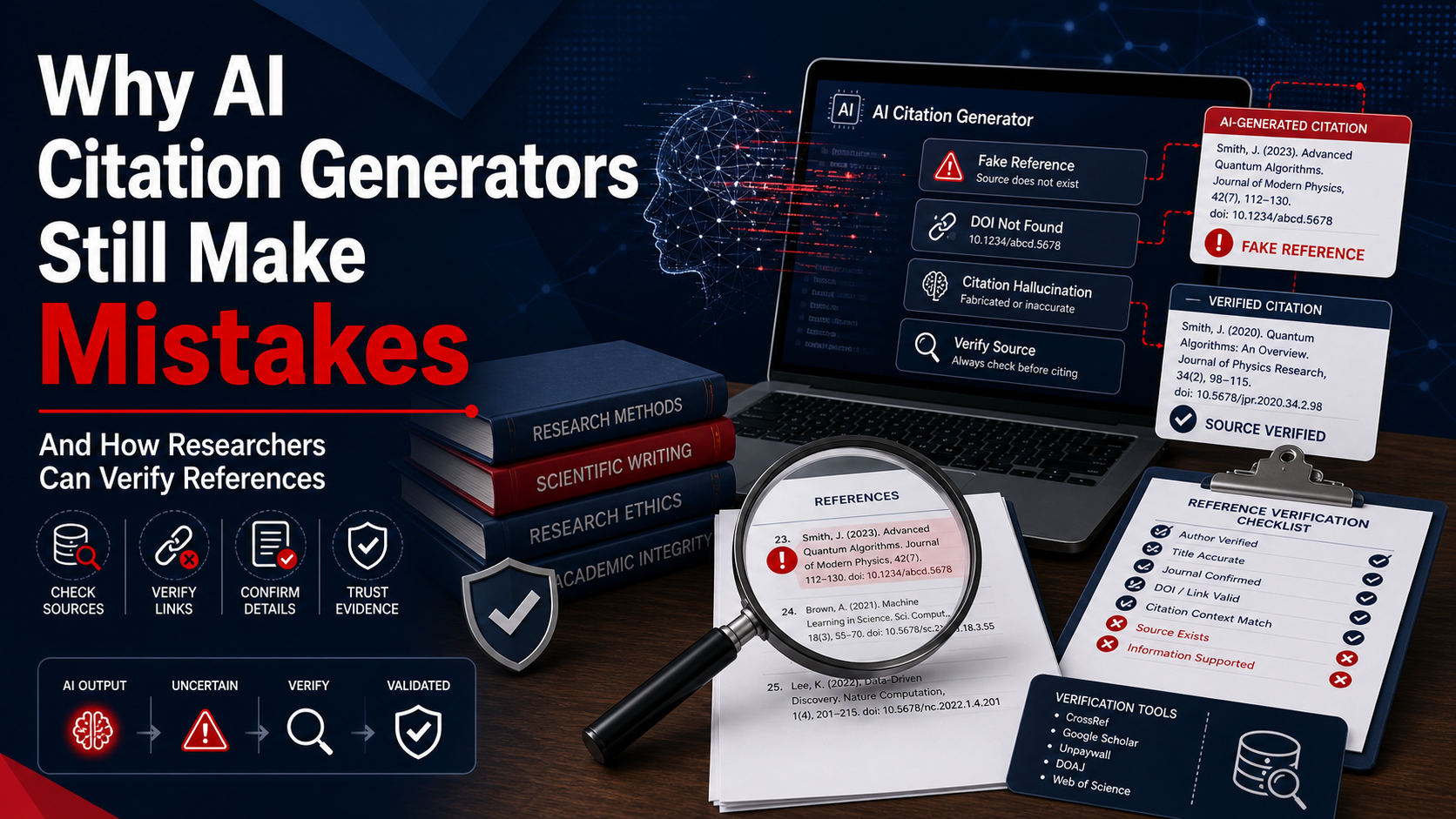
Why AI Citation Generators Still Make Mistakes (And How Researchers Can Verify References)
Artificial intelligence has transformed how researchers discover, summarize, and organize information.
Today, tools such as ChatGPT, Gemini, Claude, SciSpace, Elicit, and numerous AI-powered writing assistants can generate references and citations almost instantly.
For busy researchers, this sounds like a dream.
Type a prompt.
Receive a perfectly formatted citation.
Move on.
Unfortunately, reality is more complicated.
Many researchers assume that because an AI-generated citation looks professional, it must be accurate.
This assumption has created a growing problem in academic publishing:
Fake, incomplete, and inaccurate references generated by AI systems.
As AI adoption increases across academia, understanding how citation generators work and where they fail has become essential for maintaining research integrity.
The Growing Problem of AI-Generated References
Since the rise of large language models, publishers, editors, and peer reviewers have reported increasing numbers of manuscripts containing references that do not exist.
These citations often appear legitimate because they include:
• Real author names
• Real journal titles
• Real-sounding article titles
• Plausible publication years
• Proper formatting
However, upon verification, the articles cannot be found.
Researchers often discover that:
• The DOI does not exist
• The article title was fabricated
• The author list is incorrect
• The journal issue never existed
• Multiple real papers were merged into one fictional citation
These errors are commonly referred to as AI hallucinations.
Why AI Citation Generators Make Mistakes
Many researchers misunderstand how generative AI works.
Large language models do not operate like academic databases.
When you ask ChatGPT for references, the model does not automatically search scholarly databases unless it has access to external retrieval systems.
Instead, it predicts text patterns based on training data.
This means the model is attempting to generate what a citation should look like rather than verifying whether the citation actually exists.
As a result, AI systems may confidently generate references that appear authentic but are entirely fictional.
Common Citation Errors Produced by AI
1. Fabricated References
The most serious problem.
AI may invent an article that has never been published.
The citation often looks convincing enough to fool readers who do not verify it.
2. Incorrect Author Lists
Researchers frequently encounter:
• Missing authors
• Additional authors
• Incorrect author order
• Misspelled author names
This can create attribution and credibility issues.
3. Wrong Publication Details
AI-generated references may contain:
• Incorrect volume numbers
• Wrong issue numbers
• Incorrect page ranges
• Incorrect publication years
Even if the article exists, these details may be inaccurate.
4. Fake or Invalid DOIs
A DOI provides a permanent identifier for scholarly content.
AI systems sometimes generate DOI formats that appear valid but do not resolve to any publication.
5. Citation Style Errors
Although AI often performs well with formatting, mistakes still occur in:
• APA
• Vancouver
• Harvard
• MLA
• Chicago
• Journal-specific formats
Formatting issues may seem minor, but they can result in manuscript revisions and editorial concerns.
Why This Matters for Researchers
Many researchers assume citation mistakes are harmless.
They are not.
Inaccurate references can lead to:
• Loss of credibility
• Reviewer criticism
• Editorial concerns
• Delayed publication
• Retractions in extreme cases
Most importantly, fake citations undermine the reliability of scientific literature.
Research depends on verifiable evidence.
If readers cannot locate cited sources, the foundation of scholarly communication begins to weaken.
Real Examples of AI Citation Problems
Several studies and editorials published since the emergence of ChatGPT have documented cases where AI-generated references contained significant inaccuracies.
Researchers evaluating AI-generated bibliographies have repeatedly found:
• Non-existent publications
• Incorrect metadata
• Broken references
• Hallucinated DOIs
• Inconsistent citation details
The problem is not limited to one AI model.
Similar issues have been observed across multiple generative AI systems.
Can Researchers Trust AI for Citations?
The answer is:
AI can assist with citations, but it should never be the final authority.
Think of AI as a research assistant.
Not a reference database.
AI can help:
✅ Identify possible papers
✅ Suggest keywords
✅ Generate citation formats
✅ Organize references
AI should not be trusted to:
❌ Verify existence
❌ Confirm publication details
❌ Validate DOIs
❌ Confirm author lists
Without independent verification.
A Practical Reference Verification Workflow
Researchers can dramatically reduce citation errors by following a simple verification process.
Step 1: Verify Every Citation Individually
Never assume a citation is correct simply because it appears professionally formatted.
Check each reference independently.
Step 2: Search the Article Title
Use trusted databases such as:
• Google Scholar
• PubMed
• Crossref
• Scopus
• Web of Science
If the article cannot be found, investigate further.
Step 3: Verify the DOI
A valid DOI should resolve to the original publication.
If a DOI does not resolve correctly, it may be incorrect or fabricated.
Step 4: Confirm Authors and Metadata
Verify:
• Author names
• Journal title
• Publication year
• Volume
• Issue
• Page numbers
Small discrepancies can create major citation problems later.
Step 5: Use Reference Management Software
Tools such as:
• Zotero
• Mendeley
• EndNote
retrieve metadata directly from verified sources.
These tools generally provide more reliable citation information than generative AI alone.
Better Ways to Use AI in Reference Management
Rather than asking AI to generate citations from scratch, consider using AI for:
Literature Discovery
Finding relevant research topics.
Search Strategy Development
Generating keywords and search queries.
Article Summarization
Understanding complex papers faster.
Research Organization
Managing notes and literature reviews.
These use cases tend to be more reliable than citation generation.
What Publishers and Universities Are Saying
Many academic publishers now emphasize that authors remain fully responsible for all references included in a manuscript.
Using AI does not transfer responsibility.
Researchers must verify:
• Accuracy
• Authenticity
• Attribution
• Completeness
The author remains accountable regardless of how the citation was created.
Researcher Resource
🚀 FREE RESEARCHER RESOURCE
AI in Research: The Complete Ethical Researcher's Guide (2026 Edition)
Learn how to use AI responsibly across literature reviews, manuscript writing, reference verification, disclosure requirements, prompt engineering, and ethical research workflows.
Key Takeaways
✅ AI citation generators can produce convincing but incorrect references.
✅ Common errors include fabricated papers, fake DOIs, and inaccurate metadata.
✅ Researchers remain responsible for verifying every citation they include.
✅ Reference management software often provides more reliable metadata than generative AI.
✅ Verification should be a mandatory step before manuscript submission.
Final Thoughts
AI is becoming an increasingly valuable research companion.
However, citation generation remains one of the areas where human oversight is essential.
A reference that looks correct is not necessarily a reference that exists.
Researchers who blindly trust AI-generated citations risk introducing inaccuracies into their work, damaging credibility, and creating avoidable publication problems.
The most effective approach is simple:
Use AI to accelerate research.
Use verification to protect research integrity.
The future belongs not to researchers who avoid AI, but to researchers who know how to use it responsibly.
Frequently Asked Questions
Can ChatGPT generate accurate citations?
Sometimes. However, ChatGPT and other AI tools can also generate fabricated or inaccurate references. Every citation should be independently verified.
Why does AI invent references?
Large language models predict text patterns rather than directly verifying information from academic databases. This can result in hallucinated citations.
Are AI-generated citations plagiarism?
Not necessarily. The bigger concern is accuracy. Using non-existent references can create credibility and integrity issues.
What is the best way to verify references?
Researchers should check references through trusted databases such as Google Scholar, PubMed, Crossref, Scopus, or Web of Science.
Should researchers stop using AI for citations?
No. AI can be useful for discovering literature and organizing references, but verification should always remain a human responsibility.
Source Verification
This article is based on information obtained from:
• COPE (Committee on Publication Ethics) guidance on AI use in scholarly publishing
• Crossref documentation and DOI verification standards
• Publisher guidance from Elsevier, Springer Nature, Wiley, and Taylor & Francis
• Peer-reviewed studies evaluating the accuracy of AI-generated citations and bibliographies
• Official academic integrity guidance from universities and scholarly publishing organizations
Verification Status
All factual claims were reviewed against available scholarly publishing guidance and peer-reviewed discussions regarding AI-generated references and citation accuracy.
Last Verified
25 June 2026