Scientists Use Generative AI to Design Custom Proteins in Seconds, Transforming Drug Discovery
Artificial intelligence is rapidly changing the future of medicine, and one of its most promising applications is the design of entirely new proteins from scratch. Researchers are now using generative AI systems capable of creating custom proteins in seconds, reducing a process that traditionally required years of laboratory experimentation and iterative testing.
Proteins are fundamental biological molecules responsible for nearly every function within living organisms. Their complex three-dimensional structures determine how they interact with cells, pathogens, and therapeutic compounds. Designing proteins with specific functions has long been one of biotechnology's greatest challenges due to the immense number of possible amino acid combinations and structural configurations.
Recent advances in generative artificial intelligence are helping scientists overcome these limitations. Instead of relying on slow trial-and-error methods, researchers can now use AI systems to generate proteins specifically engineered to interact with disease targets.
One of the most significant developments is RFdiffusion, a protein design framework developed by researchers at the Institute for Protein Design. The system applies diffusion-based generative modeling techniques, similar to those used in AI image generation, to create highly stable protein structures. Starting from random noise, the model gradually constructs protein backbones optimized to bind specific biological targets.
Another breakthrough comes from researchers at the University of Virginia School of Medicine, who developed YuelDesign, an AI-powered platform designed to improve drug discovery. Unlike traditional approaches that treat proteins as static structures, YuelDesign accounts for the natural flexibility and movement of biological targets. This dynamic modeling allows scientists to design therapeutic molecules that can better adapt to changing protein conformations.
Researchers are also combining these generative systems with advanced structure prediction platforms such as AlphaFold 2. Once an AI-generated protein sequence is produced, prediction models help evaluate whether the synthetic sequence is likely to fold into the intended three-dimensional structure before laboratory testing begins.
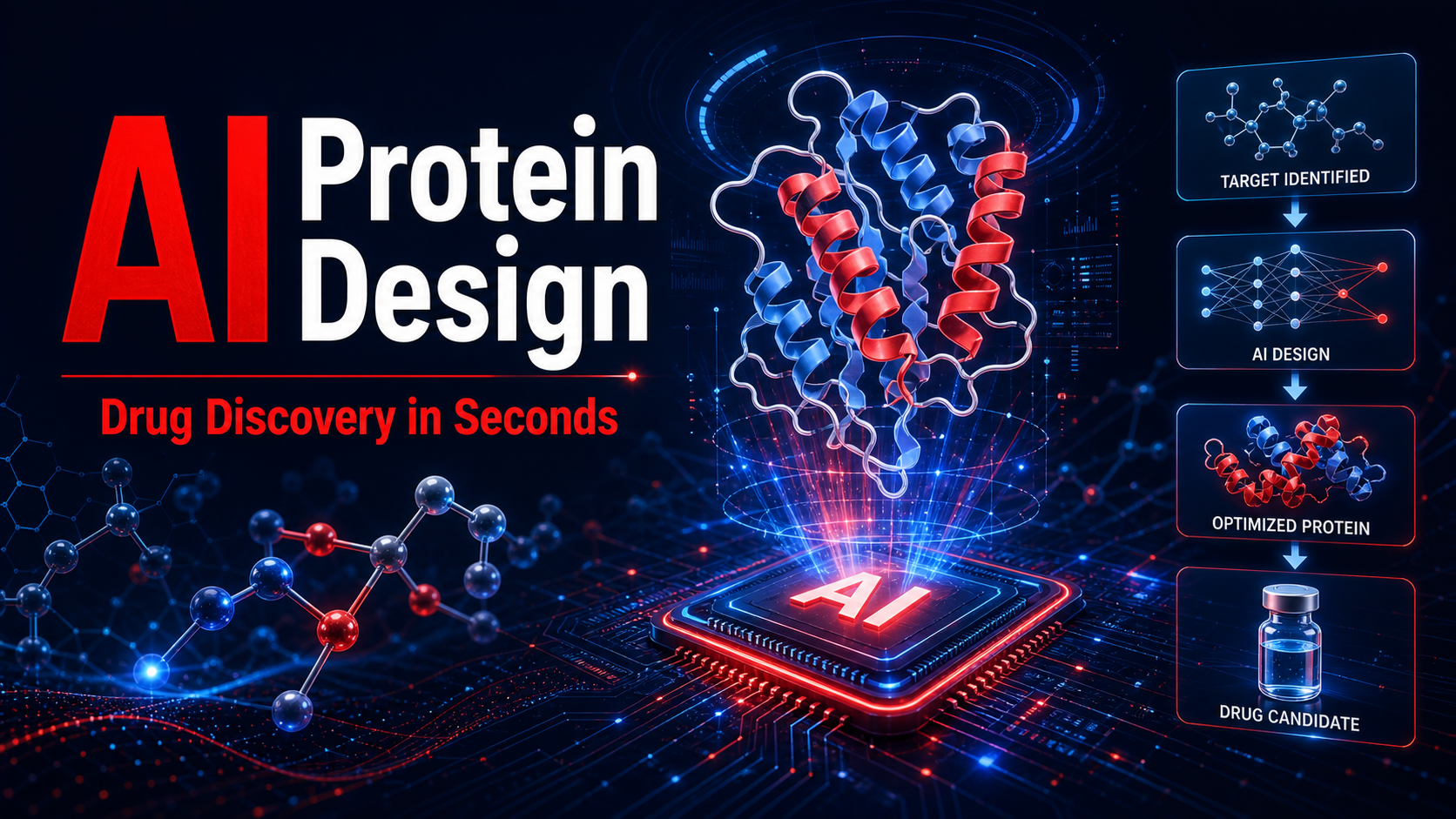
How the Process Works
The modern AI-driven protein design workflow generally follows three major steps:
1. Target Identification
Scientists first identify a biological target associated with a disease, such as a cancer-related protein, viral surface receptor, or bacterial enzyme. The target's three-dimensional structure is provided as input to the AI system.
2. Computational Design
The AI generates a completely new protein sequence engineered to bind, block, or modify the target's biological activity. Rather than searching existing biological databases, the system creates novel molecular structures specifically optimized for the intended purpose.
3. Laboratory Validation
The designed amino acid sequence is converted into DNA and synthesized in biological systems such as bacteria or yeast. Researchers then evaluate the protein's stability, functionality, and therapeutic potential through experimental testing.
The resulting molecules function as highly specialized biological tools, often compared to custom-made keys designed to fit specific molecular locks.
Potential Applications
The ability to rapidly generate functional proteins could transform multiple areas of healthcare and biotechnology:
• Development of targeted cancer therapies.
• Design of novel antibodies against infectious diseases.
• Discovery of treatments for antibiotic-resistant bacterial infections.
• Engineering of therapeutic proteins for rare genetic disorders.
• Creation of industrial enzymes for sustainable manufacturing processes.
• Acceleration of vaccine research and development.
Challenges and Future Directions
Despite these advances, AI-generated proteins must still undergo extensive laboratory validation before they can be used in clinical settings. Safety, effectiveness, stability, and manufacturability remain critical considerations. Researchers emphasize that artificial intelligence serves as a powerful design tool rather than a replacement for experimental science.
As generative AI models continue to improve, experts believe the technology could significantly reduce drug development timelines and costs while expanding the range of diseases that can be targeted through precision therapeutics.
The integration of generative AI, protein engineering, and computational biology represents a major step toward a future where medicines can be designed with unprecedented speed and precision.
Why This Matters
• Reduces years of protein design work to seconds.
• Accelerates the discovery of new medicines.
• Enables development of highly targeted therapies.
• Supports treatment innovation for complex diseases.
• Demonstrates the growing impact of artificial intelligence in biomedical research.
Frequently Asked Questions
What is generative AI in protein design?
Generative AI uses machine learning models to create entirely new protein structures and sequences optimized for specific biological functions.
What is RFdiffusion?
RFdiffusion is an AI-based protein design framework developed by the Institute for Protein Design that generates stable protein structures using diffusion modeling techniques.
How does AlphaFold 2 contribute to protein design?
AlphaFold 2 predicts how protein sequences fold into three-dimensional structures, helping researchers evaluate AI-generated proteins before laboratory testing.
Can AI-designed proteins be used immediately in medicine?
No. All AI-generated therapeutic candidates must undergo rigorous laboratory, preclinical, and clinical testing before they can be approved for medical use.
This article is based on information obtained from:
• Original peer-reviewed scientific publication:
A Review of Generative Artificial Intelligence in Drug Discovery and Development (2025)
• Official university announcement:
University of Virginia School of Medicine
• Supporting scientific and institutional sources
Last verified on: 15 June 2026
Sources:
• https://www.news-medical.net/news/20260409/UVA-scientists-develop-AI-tools-to-accelerate-new-drug-discovery.aspx
• https://www.sciencedirect.com/science/article/pii/S2590098625000107